A couple of weeks ago Ellen Griffin, Dean of Continuing Education at Southern New Hampshire University, was a guest on my radio show. The discussion was the increase in baby boomers returning to the classroom, the reasons and the opportunities.
Many are returning to school to increase career opportunities in their current profession, graduate program enrollees have increased as well as certificate programs, others are returning to school in preparation for a career change. People are expecting to stay in the workforce longer, whether it is at their current job or a new career, and keeping current with your industry and increasing your value is necessary to remain competitive.
The ease of learning may also contribute to the rise in boomer enrollment, satellite campuses, workplace classrooms and online courses make it easier to participate and complete study programs. It is possible to complete a degree program online without leaving your house or setting foot in a classroom.
Boomers who attend a live classroom bring something to the table their younger classmate’s lack, real life experience with the subject matter. This can be a plus to someone, who is learning the theoretical workings of an issue, to have the opportunity to hear firsthand the actual application of the theory.
One area in particular that has attracted the attention of baby boomers is community service, this generation has a “give back” attitude and there is interest in bringing their management and leadership skills to the non-profit area.
A Boston Globe article on September 13, 2009 referred to the fact that people are expecting to stay in the workforce longer and fifty year olds consider themselves mid-career. The number of Americans over 65 is expected to grow to 20% of the population by 2030 and to continue to increase meanwhile the younger generations will grow at a slower pace. This will open up opportunities for older workers to continue to stay in the workforce, keeping current through education and training will strengthen their position value.

Showing posts with label investing. Show all posts
Showing posts with label investing. Show all posts
Monday, November 9, 2009
Tuesday, October 13, 2009
Make Sure Your Assets are Covered
Two weeks ago I invited Chuck Worcester, owner of Hometown Insurance, to be a guest on my radio show to talk about the importance of property, casualty and liability insurance. Having Chuck on was a good reminder to incorporate a risk management strategy as part of your total financial plan and, like the other strategies, needs monitoring and updating.
Often home and auto insurance coverage once established are put on autopilot and ignored until filing a claim becomes necessary. It is important to meet with your insurance agent and review the risk management strategy of your financial plan annually. Maintaining the proper coverage for you assets is critical to protect against damage, injury, or claims against you.
As part of the annual review of your coverage, you should:
1) Make sure your coverage is adequate for your assets and make sure all assets that need insurance coverage are covered. Your life changes and so do the assets you own, keep your agent aware of purchases that will require insurance and make sure they are covered.
2) Make sure your agent knows how certain properties will be used (business or property) and who will be using it (employees, family, etc). This is especially important when you are insuring vehicles and equipment or allowing others access to use your property.
3) Make sure you have adequate liability coverage. Insuring against a piece of property being damaged or stolen is not enough you need to have coverage for damage and injury to others. A large claim or lawsuit against you may exceed your policy’s coverage consider a separate liability umbrella policy for greater protection.
4) Make sure you are getting the best coverage for your dollar. Have your agent compare rates and coverage but remember cheapest is not always best.
Losing the use of property due to damage or a lawsuit against you due to negligence, injury or damage to other’s property can be devastating. You can’t control all the risks out there, accidents happen but you need to be prepared, and maintaining an active risk management strategy can offer protection. Don’t ignore this critical strategy from your financial plan.
Often home and auto insurance coverage once established are put on autopilot and ignored until filing a claim becomes necessary. It is important to meet with your insurance agent and review the risk management strategy of your financial plan annually. Maintaining the proper coverage for you assets is critical to protect against damage, injury, or claims against you.
As part of the annual review of your coverage, you should:
1) Make sure your coverage is adequate for your assets and make sure all assets that need insurance coverage are covered. Your life changes and so do the assets you own, keep your agent aware of purchases that will require insurance and make sure they are covered.
2) Make sure your agent knows how certain properties will be used (business or property) and who will be using it (employees, family, etc). This is especially important when you are insuring vehicles and equipment or allowing others access to use your property.
3) Make sure you have adequate liability coverage. Insuring against a piece of property being damaged or stolen is not enough you need to have coverage for damage and injury to others. A large claim or lawsuit against you may exceed your policy’s coverage consider a separate liability umbrella policy for greater protection.
4) Make sure you are getting the best coverage for your dollar. Have your agent compare rates and coverage but remember cheapest is not always best.
Losing the use of property due to damage or a lawsuit against you due to negligence, injury or damage to other’s property can be devastating. You can’t control all the risks out there, accidents happen but you need to be prepared, and maintaining an active risk management strategy can offer protection. Don’t ignore this critical strategy from your financial plan.

Monday, August 10, 2009
Time For a Plan Review
We are a little more than halfway through summer and it has been an odd one to say the least. Here in New England June and July were rainy and raw. Now that August has arrived, it seems as though summer is finally here, hopefully it will last into September and October.
Since many of us take advantage of down time to recharge and regroup during the summer, this is a good time to set aside a bit of time to review your life/financial plan. Some of the areas you want to touch on are:
1. Personal goals and timelines; are you still on track or do you need to extend or adjust your original thoughts?
2. Finances; are your investments and savings strategies aligned with your goals? Have you reviewed your current cash flow; is it in line or are you running a deficit each month? Do you foresee any major expenses or windfalls in the near future?
3. Are you maintaining enough insurance on your life and property?
4. Have you created an estate plan and have you reviewed it recently? Review your wills, trusts, and beneficiaries every few years to make sure they are current with your wishes.
5. Have you considered a Power-of Attorney for finances, Power-of Attorney for health care, and Living Will?
These are just a few of the topics that make up a life/financial plan, your situation and needs determine priority. Remember your plan is not a static document, life changes, tax and law changes, good events, and bad events will all cause an adjustment in your plan.
Since many of us take advantage of down time to recharge and regroup during the summer, this is a good time to set aside a bit of time to review your life/financial plan. Some of the areas you want to touch on are:
1. Personal goals and timelines; are you still on track or do you need to extend or adjust your original thoughts?
2. Finances; are your investments and savings strategies aligned with your goals? Have you reviewed your current cash flow; is it in line or are you running a deficit each month? Do you foresee any major expenses or windfalls in the near future?
3. Are you maintaining enough insurance on your life and property?
4. Have you created an estate plan and have you reviewed it recently? Review your wills, trusts, and beneficiaries every few years to make sure they are current with your wishes.
5. Have you considered a Power-of Attorney for finances, Power-of Attorney for health care, and Living Will?
These are just a few of the topics that make up a life/financial plan, your situation and needs determine priority. Remember your plan is not a static document, life changes, tax and law changes, good events, and bad events will all cause an adjustment in your plan.
Tuesday, June 2, 2009
The Mike Bonacorsi Show
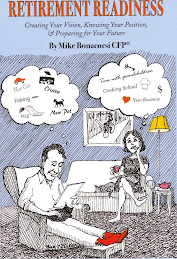
My radio show based on my award winning book "Retirement Readiness; Creating Your Vision, Knowing Your Position, & Preparing for Your Future" is broadcast every Tuesday at Noon til 1 pm EST on WSMN Radio AM 1590.
To hear my broadcast live go to http://www.wsmnradio.com/ Tuesdays at Noon.
You can also listen on PodBean.com at http://mikebonacorsi.podbean.com/
The podcast is new so check back for updates as I will be adding more shows to the list.
To hear my broadcast live go to http://www.wsmnradio.com/ Tuesdays at Noon.
You can also listen on PodBean.com at http://mikebonacorsi.podbean.com/
The podcast is new so check back for updates as I will be adding more shows to the list.
Monday, June 1, 2009
Financial Planning is More Than Money: How strategies fit into Plans
What is the difference between a strategy and plan in charting your course for retirement? Strategies are the options you might follow to meet different goals. A plan is a global document that encompasses a number of goals equally and consists of action steps that help you to meet those goals.
I was reminded of this difference recently when reviewing the “plan” created by Lou, a friend of mine. Lou asked if I would, “take a look” at his plan and offer an opinion. He handed me a document that was several pages long, which contained the results of a risk analyzer and portfolio recommendations. I could see that he had spent some time creating this.
I immediately thought of the difference between strategies and plans and said, “This is interesting as a strategy, but lacking as a plan.” He looked puzzled at my comment and I went on to explain, a true financial plan is a life plan. It starts with a vision of how you see your future, creating goals, setting priorities.
Once your goals are set, then you develop strategies. These should consist of more than building a portfolio. Strategies are the engine that drives you to your vision. They are the action steps that lead you to meet your goals. They must be comprehensive to be truly effective. Like an engine, which cannot run efficiently on a few cylinders, throwing together various strategies, without a global plan, will only get you spotty results and ultimately misfires. Strategies include creating timelines, understanding all areas of money management, insuring and protecting against catastrophe, and creating a Plan B for the unexpected.
A plan is an active document--an evolving project--which requires monitoring, tweaking and updating. Changes in your job, relationships, health, and financials will necessitate updates and adjustments. When priorities change, one goal may be accomplished, while another is added to replace it. For instance; the birth of a child or grandchild, may add college planning to the plan, or health issues may require additional care costs. Changes in relationships may require revamping your estate planning goals.
When the plan is active and not set in stone, you can easily readjust and keep moving forward. Making sure you stay on target to your goals will require vigilance. You will be updating and rebalancing your accounts, making adjustments in your strategies, and revisiting your timelines.
Try thinking of building a life, or financial, plan along the lines of taking a long journey. First, you have a vision of the trip, decide upon the various stops along the way, and then chart the route you will travel. Your vision becomes stronger, once you have that map out, the car goes into the garage for a tune-up, and the hotels are booked. Once begun, the journey is likely to follow twists and turns you didn’t plan for and yet they add to the value of the experience. The restaurant you found on the back street when you took a wrong turn, the bad weather that caused you to postpone the canyon hiking for a trip to an antique shop full of bargains, all contribute to the evolving nature of an active journey. It’s always changing and that allows you to make the best of whatever comes your way.
As you build your life/financial plan, keep these thoughts in mind:
Start with a vision.
1. Set timelines for goals.
2. Create strategies that align with your goals.
3. Monitor, adjust, rethink, tweak.
4. The destination you reach may be more wonderful than you ever imagined.
About Mike Bonacorsi, CFP®
Mike Bonacorsi is a CERTIFIED FINANCIAL PLANNER™ professional, public speaker and award-winning author of Retirement Readiness: A Guide to Creating Your Vision, Knowing Your Position, and Preparing for Your Future. You can listen to his radio show, The Mike Bonacorsi Show, at WSMN, 1590AM or on your computer at http://wsmnradio.com on Tuesdays from noon – 1:00 PM. For additional information, visit http://mikebonacorsi.com/. Reprinted with permission of the author. 2009© Mike Bonacorsi CFP® All Rights Reserved.
I was reminded of this difference recently when reviewing the “plan” created by Lou, a friend of mine. Lou asked if I would, “take a look” at his plan and offer an opinion. He handed me a document that was several pages long, which contained the results of a risk analyzer and portfolio recommendations. I could see that he had spent some time creating this.
I immediately thought of the difference between strategies and plans and said, “This is interesting as a strategy, but lacking as a plan.” He looked puzzled at my comment and I went on to explain, a true financial plan is a life plan. It starts with a vision of how you see your future, creating goals, setting priorities.
Once your goals are set, then you develop strategies. These should consist of more than building a portfolio. Strategies are the engine that drives you to your vision. They are the action steps that lead you to meet your goals. They must be comprehensive to be truly effective. Like an engine, which cannot run efficiently on a few cylinders, throwing together various strategies, without a global plan, will only get you spotty results and ultimately misfires. Strategies include creating timelines, understanding all areas of money management, insuring and protecting against catastrophe, and creating a Plan B for the unexpected.
A plan is an active document--an evolving project--which requires monitoring, tweaking and updating. Changes in your job, relationships, health, and financials will necessitate updates and adjustments. When priorities change, one goal may be accomplished, while another is added to replace it. For instance; the birth of a child or grandchild, may add college planning to the plan, or health issues may require additional care costs. Changes in relationships may require revamping your estate planning goals.
When the plan is active and not set in stone, you can easily readjust and keep moving forward. Making sure you stay on target to your goals will require vigilance. You will be updating and rebalancing your accounts, making adjustments in your strategies, and revisiting your timelines.
Try thinking of building a life, or financial, plan along the lines of taking a long journey. First, you have a vision of the trip, decide upon the various stops along the way, and then chart the route you will travel. Your vision becomes stronger, once you have that map out, the car goes into the garage for a tune-up, and the hotels are booked. Once begun, the journey is likely to follow twists and turns you didn’t plan for and yet they add to the value of the experience. The restaurant you found on the back street when you took a wrong turn, the bad weather that caused you to postpone the canyon hiking for a trip to an antique shop full of bargains, all contribute to the evolving nature of an active journey. It’s always changing and that allows you to make the best of whatever comes your way.
As you build your life/financial plan, keep these thoughts in mind:
Start with a vision.
1. Set timelines for goals.
2. Create strategies that align with your goals.
3. Monitor, adjust, rethink, tweak.
4. The destination you reach may be more wonderful than you ever imagined.
About Mike Bonacorsi, CFP®
Mike Bonacorsi is a CERTIFIED FINANCIAL PLANNER™ professional, public speaker and award-winning author of Retirement Readiness: A Guide to Creating Your Vision, Knowing Your Position, and Preparing for Your Future. You can listen to his radio show, The Mike Bonacorsi Show, at WSMN, 1590AM or on your computer at http://wsmnradio.com on Tuesdays from noon – 1:00 PM. For additional information, visit http://mikebonacorsi.com/. Reprinted with permission of the author. 2009© Mike Bonacorsi CFP® All Rights Reserved.
Sunday, May 3, 2009
Introduction to Retirement Readiness, Creating Your Vision, Knowing Your Position, & Preparing for Your Future
This is not a book about a great investment strategy, a hot new product, or a guarantee of any kind. I wrote it to get you thinking about retirement before it happens.
Too many times over the years, I've met with people who've already made the leap into retirement without any real direction or thought. They want a lifestyle that doesn't match up with their finances; they make decisions based on what may or may not be working for someone else.
As you read this book, I want you to create a retirement life that is yours. Your dreams, goals, and ambitions should be based on your situation. To do this, we’ll create a vision, asses your situation, and prepare for the unexpected.
Read this book a few times- throw it in your briefcase, on your nightstand, in a desk drawer. Make sure it’s somewhere accessible. This is an interactive book. Answer the questions at the end of each section, be honest, and share your answers with your spouse.
More important, read this book before you retire, so you can hit the ground running on the day you declare yourself retired.
Last, I want this book to get you thinking. You have to make these decisions once in your life, and there are pros and cons for each decision. Don’t hesitate to seek out the advice of a financial professional for further input on creating a retirement plant that will fit your needs.
This book is available on Amazon.com at a 22% discount!
http://www.amazon.com/Retirement-Readiness-Creating-Position-Preparing/dp/193180771X
Too many times over the years, I've met with people who've already made the leap into retirement without any real direction or thought. They want a lifestyle that doesn't match up with their finances; they make decisions based on what may or may not be working for someone else.
As you read this book, I want you to create a retirement life that is yours. Your dreams, goals, and ambitions should be based on your situation. To do this, we’ll create a vision, asses your situation, and prepare for the unexpected.
Read this book a few times- throw it in your briefcase, on your nightstand, in a desk drawer. Make sure it’s somewhere accessible. This is an interactive book. Answer the questions at the end of each section, be honest, and share your answers with your spouse.
More important, read this book before you retire, so you can hit the ground running on the day you declare yourself retired.
Last, I want this book to get you thinking. You have to make these decisions once in your life, and there are pros and cons for each decision. Don’t hesitate to seek out the advice of a financial professional for further input on creating a retirement plant that will fit your needs.
This book is available on Amazon.com at a 22% discount!
http://www.amazon.com/Retirement-Readiness-Creating-Position-Preparing/dp/193180771X
Saturday, May 2, 2009
Who Says You Have To Retire At 65?
Do you want your retirement years to be lively? Is your current job or career, fulfilling for you? If so, then maybe you are going to be joining the happy, busy ranks of those, more than 70% according to a recent A.A.R.P. survey, who are planning a "working retirement." If working past your retirement date seems grim, then cheer up. There is a silver lining if you know where to look.
1) Continuing at your current job has its positives - you know the job. There are no learning curves, or the awkwardness of being the new kid.
2) If you have personal debt or you are close to paying off your mortgage, working a few more years at your current income can go a long way to eliminating expenses.
3) Continuing to draw a paycheck will allow you to delay Social Security, for a higher benefit in the near future. Your benefit will continue to increase up to age 70. Keeping that weekly paycheck coming will also prevent you from drawing down your savings too early.
4) Chances are if you are near retirement, you may be close to peak earning and benefit levels. Perhaps you want to boost your 401k levels by maxing out your contribution and taking advantage of the over 50 catch-up contribution. Your employer may even contribute to your account adding to your total. Health benefits will probably continue and can provide continued coverage for you, your spouse and possibly other family members. It can also provide as a bridge to Medicare or act as a supplement.
5) You might not be ready to quit working. You may need income, require some benefits, or just like to work. There are many people out there, who enjoy the challenges work brings and going out there each day to meet them. For you "retirement" may the beginning of a new career!
You may be feeling like "George." His wife Linda says, "George is in his sixties and while all our friends are talking about retiring, he doesn't want to quit. George likes his job, he has the option to continue full-time, or work in a per diem arrangement, as long as he wants. He's the kind of person that needs to be busy. The income and flexibility in his job will allow us plenty of opportunity to enjoy ourselves without worrying about money. I have already stopped working, but this doesn't mean that my husband will. As long as we can enjoy more time together, then I am satisfied with his decision to stay in the workforce, for now." Linda and George have different dreams about retirement, but they have created a plan that works for them. Where do your dreams fit into your plans for retirement?
1) Continuing at your current job has its positives - you know the job. There are no learning curves, or the awkwardness of being the new kid.
2) If you have personal debt or you are close to paying off your mortgage, working a few more years at your current income can go a long way to eliminating expenses.
3) Continuing to draw a paycheck will allow you to delay Social Security, for a higher benefit in the near future. Your benefit will continue to increase up to age 70. Keeping that weekly paycheck coming will also prevent you from drawing down your savings too early.
4) Chances are if you are near retirement, you may be close to peak earning and benefit levels. Perhaps you want to boost your 401k levels by maxing out your contribution and taking advantage of the over 50 catch-up contribution. Your employer may even contribute to your account adding to your total. Health benefits will probably continue and can provide continued coverage for you, your spouse and possibly other family members. It can also provide as a bridge to Medicare or act as a supplement.
5) You might not be ready to quit working. You may need income, require some benefits, or just like to work. There are many people out there, who enjoy the challenges work brings and going out there each day to meet them. For you "retirement" may the beginning of a new career!
You may be feeling like "George." His wife Linda says, "George is in his sixties and while all our friends are talking about retiring, he doesn't want to quit. George likes his job, he has the option to continue full-time, or work in a per diem arrangement, as long as he wants. He's the kind of person that needs to be busy. The income and flexibility in his job will allow us plenty of opportunity to enjoy ourselves without worrying about money. I have already stopped working, but this doesn't mean that my husband will. As long as we can enjoy more time together, then I am satisfied with his decision to stay in the workforce, for now." Linda and George have different dreams about retirement, but they have created a plan that works for them. Where do your dreams fit into your plans for retirement?
Subscribe to:
Posts (Atom)